Governing the Future State of the Codebase
Introduction
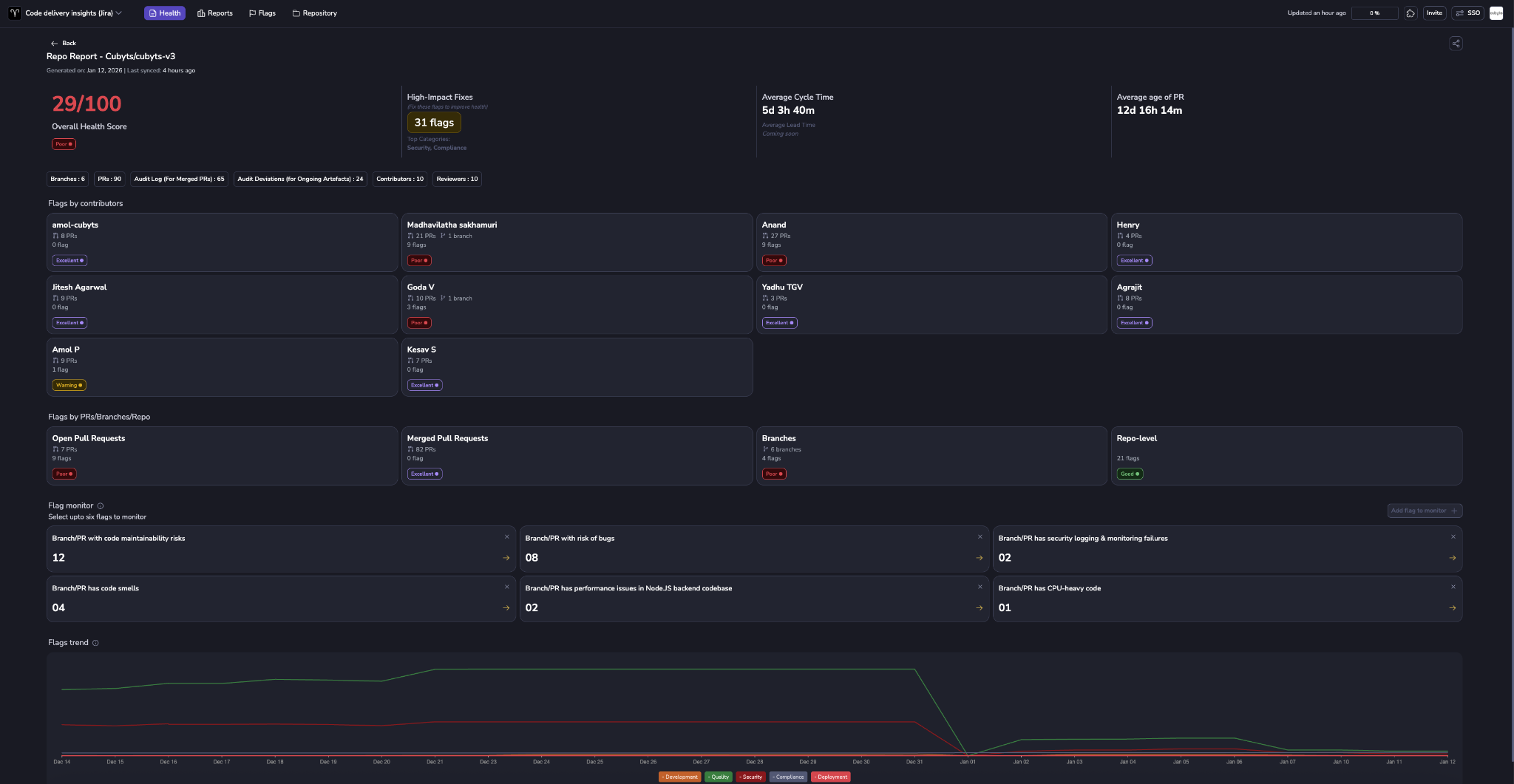
Predictive Repository Health governance provides a forward-looking assessment of codebase stability, quality, and risk. Unlike sprint or retrospective governance, this layer is not tied to delivery milestones. Instead, it continuously evaluates how current development activity is shaping the future state of the repository.
This enables organisations to identify and mitigate risks before they manifest as defects, security incidents, or delivery slowdowns.
Governance Objective
The objective of Predictive Repository Health governance is to ensure that the codebase remains:
Sustainable as it evolves
Secure as new changes are introduced
Performant and maintainable over time
By predicting future degradation, this governance layer enables pre-emptive intervention rather than reactive remediation.
How Predictive Repository Health Works
This governance layer continuously analyses signals across:
Branches and pull requests
Contributor activity and code ownership
Code quality, complexity, and maintainability indicators
Security vulnerabilities and compliance risks
Performance and dependency characteristics
These signals are synthesised into a Predictive Repository Health Score that reflects the likelihood of future degradation if current trends continue.
Predicting Technical Debt Accumulation
Predictive governance focuses on identifying early indicators of technical debt, including:
Repeated introduction of code smells
Rising complexity and maintainability risks
Performance-sensitive or CPU-heavy code paths
Risky dependency and security patterns
By identifying these signals early, teams can address root causes before debt becomes systemic.
Contributor- and Branch-Level Accountability
Predictive Repository Health governance provides visibility into where risks are forming, not just what risks exist.
This enables:
Targeted coaching and review for contributors
Focused remediation on high-risk branches
Better-informed review and merge decisions
Governance is thus distributed and actionable, not centralised or punitive.
High-Impact Fix Prioritisation
To avoid overwhelming teams, the system highlights high-impact fixes; actions that would most improve the predicted health of the repository.
This ensures that improvement efforts are:
Focused on future risk reduction
Aligned with long-term sustainability
Integrated into regular development workflows
Operational and Leadership Impact
Predictive Repository Health governance supports:
Engineering Leaders in managing long-term code quality and risk
Architects in identifying structural weaknesses early
Security and Compliance Teams in preventing future exposure
Teams by reducing unplanned rework and firefighting
It enables continuous improvement without disrupting delivery velocity.
Role in the Broader Governance Framework
Continuous Predictive Repository Health governance:
Consumes execution and outcome signals from sprint and portfolio governance
Complements retrospective learning with forward-looking insight
Acts as the preventive layer of the governance framework
Together with ongoing and retrospective governance, it completes a closed-loop governance model.
Conclusion
Predictive Repository Health governance shifts software governance from reaction to anticipation. By continuously forecasting the future state of the codebase, it enables organisations to reduce risk, control technical debt, and sustain delivery excellence over time.
Was this article helpful?
That’s Great!
Thank you for your feedback
Sorry! We couldn't be helpful
Thank you for your feedback
Feedback sent
We appreciate your effort and will try to fix the article