Governing Delivery Outcomes Across Sprints
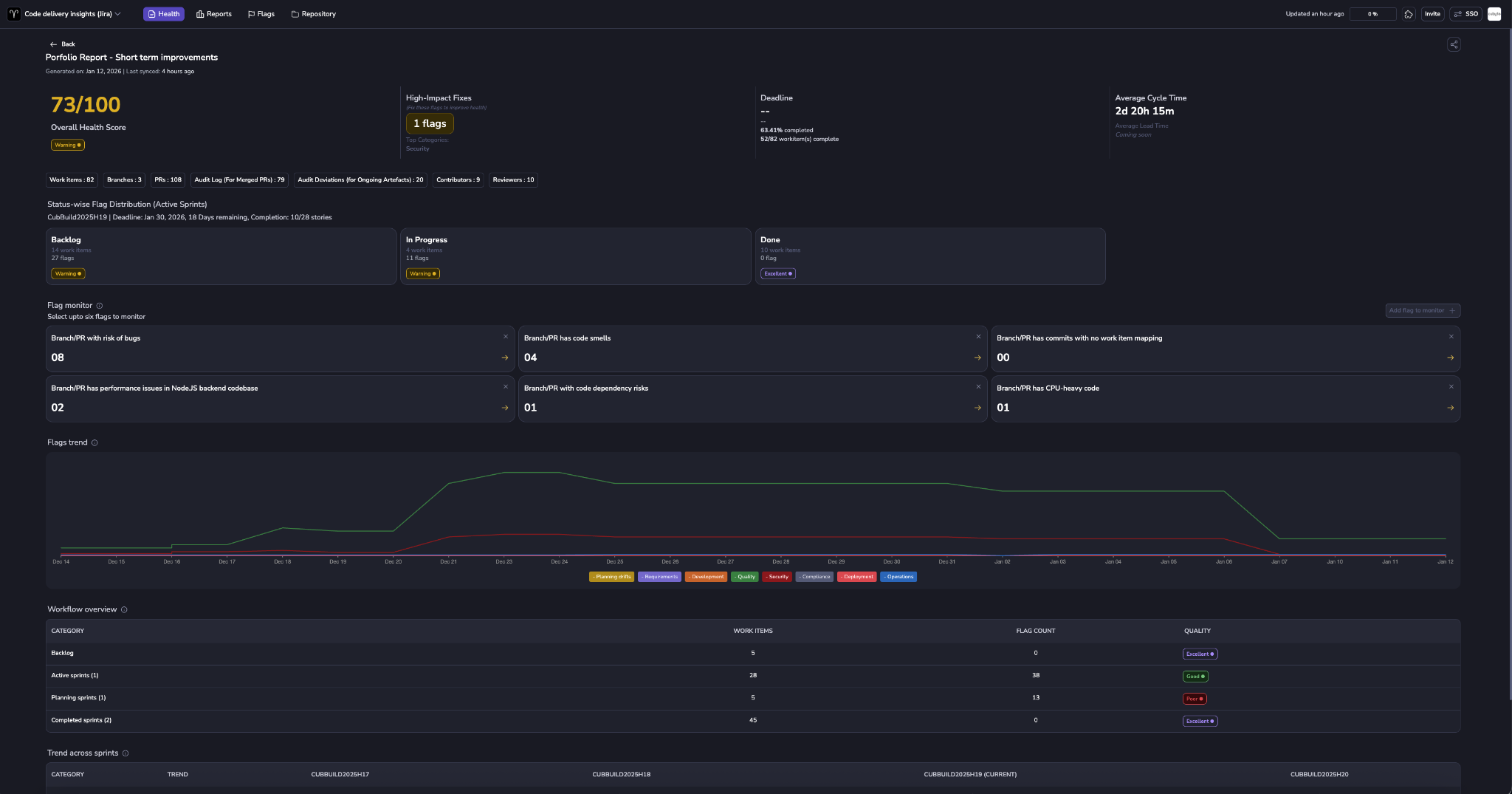
Introduction
Retrospective Portfolio Health governance provides a historical, cross-sprint view of delivery and quality performance. Rather than focusing on individual sprint execution, this governance layer analyses completed and ongoing sprints collectively to surface systemic risks, trends, and improvement opportunities.
It enables organisations to move beyond anecdotal retrospectives and establish data-driven governance at a portfolio level.
Governance Objective
The primary objective of Portfolio Health governance is to ensure that:
Delivery outcomes are consistently improving over time
Systemic issues are identified and addressed early
Retrospectives lead to measurable improvement, not repeated discussion
This governance layer focuses on learning and correction, not control during execution.
How Portfolio Health Governance Works
Portfolio Health governance aggregates signals across multiple sprints, including:
Sprint health scores and outcomes
Distribution of flags across workflow stages
Recurring risk categories such as quality, security, and planning
Trends in cycle time, completion rates, and execution stability
These signals are synthesised into a Portfolio Health Score that reflects the overall stability and maturity of delivery across teams and repositories.
Identifying Systemic Risks
Unlike sprint-level governance, Portfolio Health governance is designed to answer questions such as:
Which issues recur across sprints and teams?
Are delivery problems isolated or structural?
Are improvements sustained or short-lived?
By analysing patterns rather than events, the platform highlights systemic risks that require architectural, process, or organisational intervention.
Trend-Based Improvement Planning
Trend views across sprints enable leadership to:
Identify improving and deteriorating areas
Validate whether past corrective actions were effective
Prioritise improvement initiatives based on evidence
This shifts retrospectives from subjective discussion to fact-based decision-making.
High-Impact Improvement Focus
Portfolio Health governance highlights a small set of high-impact improvement opportunities—areas where intervention would deliver the greatest portfolio-wide benefit.
This prevents organisations from:
Overreacting to isolated sprint failures
Spreading improvement efforts too thinly
Repeating the same retrospective actions without results
Operational and Leadership Impact
Portfolio Health governance supports:
Engineering Leadership in identifying structural quality and delivery risks
PMO and Delivery Leadership in tracking portfolio stability and predictability
Teams by providing objective inputs into retrospectives and planning
It enables consistent governance without introducing additional reporting overhead.
Role in the Broader Governance Framework
Retrospective Portfolio Health governance:
Consumes execution signals from Ongoing Sprint Health governance
Feeds improvement priorities into Continuous and Predictive governance layers
Acts as the learning and calibration layer of the governance framework
Without this layer, organisations risk repeating the same issues sprint after sprint.
Conclusion
Portfolio Health governance transforms sprint outcomes into actionable, portfolio-level insights. By focusing on trends and systemic risks, it enables organisations to continuously improve delivery maturity, predictability, and quality.
Video: https://www.loom.com/share/12c93e3c9a654e5682cfe09ee68c9834
Was this article helpful?
That’s Great!
Thank you for your feedback
Sorry! We couldn't be helpful
Thank you for your feedback
Feedback sent
We appreciate your effort and will try to fix the article