Introduction
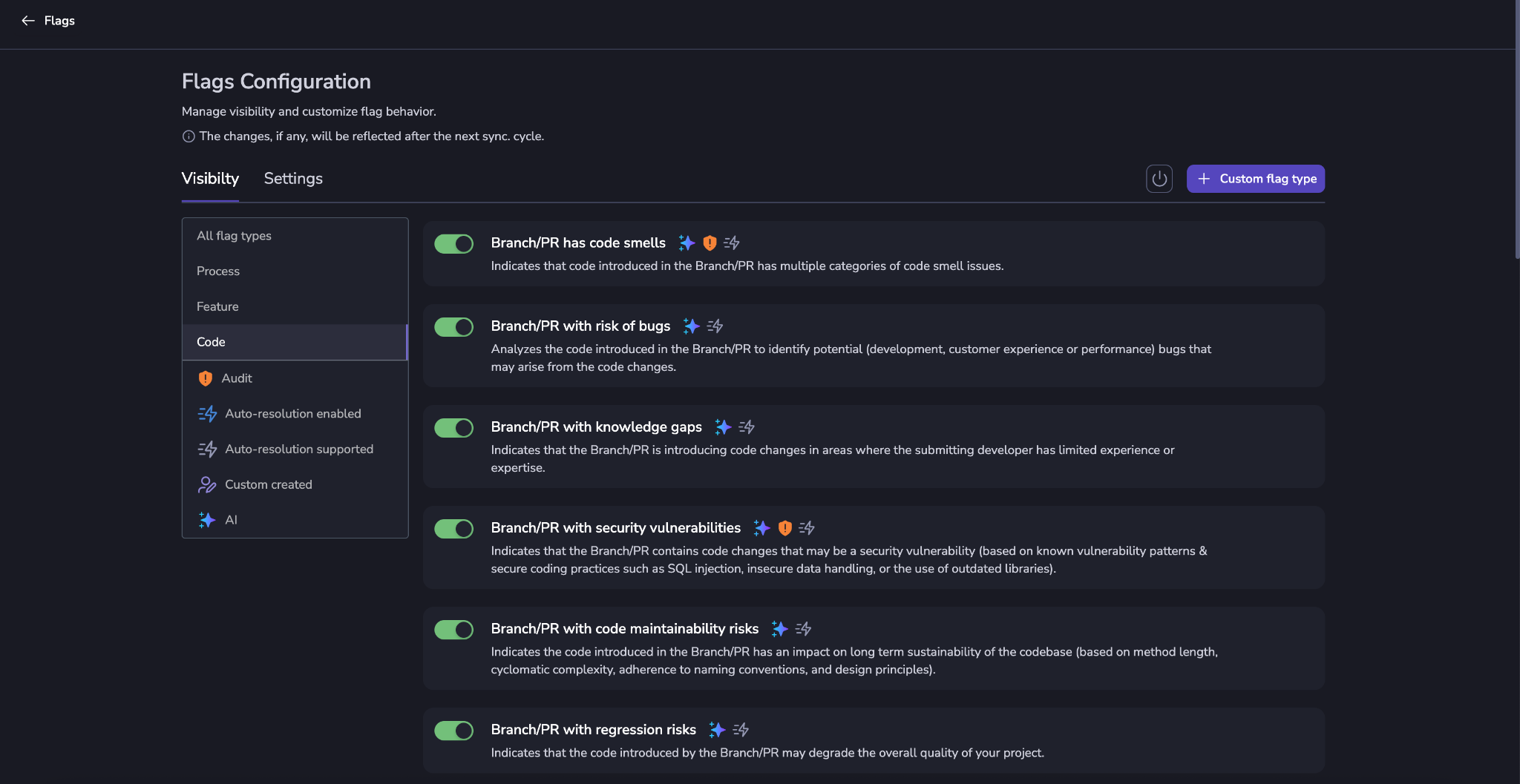
Code Flags act as governance enablers by continuously analysing code changes introduced through branches and pull requests. They ensure that quality, security, and sustainability risks are identified at the point where code is written and reviewed.
In addition to built-in quality and security intelligence, Code Flags support customer-defined governance rules, allowing organisations to extend governance to reflect their own engineering standards.
Governance Objective
The objective of Code Flags is to ensure that code entering the repository is:
Secure by design
Maintainable over time
Aligned with organisational and architectural standards
Unlikely to introduce regressions or hidden technical debt
This is achieved through a combination of platform-provided intelligence and customer-configured code flags.
What Code Flags Monitor
Code Flags continuously evaluate signals such as:
Code smells and maintainability risks
Bug and regression likelihood
Performance and dependency risks
Security vulnerabilities and misconfigurations (e.g., OWASP Top 10)
Knowledge concentration and ownership gaps
In addition, customers can define new code flags to:
Detect violations of organisation-specific coding conventions
Apply domain-specific or platform-specific security rules
Each flag represents a codified governance expectation, automatically enforced across all relevant code changes.
Custom Code Governance
Custom Code Flags allow organisations to tailor governance without modifying developer workflows. These flags:
Are evaluated automatically like built-in flags
Appear consistently in health reports and deep-dive views
Can be integrated into Git and IDE workflows for immediate feedback
This ensures governance evolves alongside the organisation’s technology stack and policies.
Linking Code Flags to Health Signals
Health reports identify where risk is accumulating; Code Flags explain why.
For example:
Predictive Repository Health degradation can be traced to recurring custom architectural violations
Sprint instability can originate from high-risk PRs flagged by internal rules
Portfolio-level quality trends can reflect persistent security or maintainability deviations
This establishes a closed-loop governance model:
Code-level signals → Health degradation → Targeted remediation
Diagnostic and Actionable Usage
Code Flags support two complementary modes:
Diagnostic governance – understanding what is going wrong and where
Actionable governance – resolving issues directly via Git and VS Code integrations
Custom and built-in flags follow the same lifecycle, ensuring a consistent governance experience.
Role in the Overall Governance Framework
Code Flags:
Complement Process and Feature Flags by governing execution outcomes
Power Predictive Repository Health with high-fidelity signals
Feed Audit and Compliance with traceable, objective evidence
They form the technical integrity layer of the governance framework.
Conclusion
Code Flags ensure that governance adapts to both industry best practices and organisation-specific standards. By combining built-in intelligence with customer-defined rules, Cubyts enables flexible, scalable, and actionable code governance at developer speed.
Was this article helpful?
That’s Great!
Thank you for your feedback
Sorry! We couldn't be helpful
Thank you for your feedback
Feedback sent
We appreciate your effort and will try to fix the article