Continuous Control of Sprint Execution
Introduction
Ongoing Sprint Health governance provides real-time oversight of sprint execution by continuously evaluating delivery against commitments, standards, and readiness signals. Unlike traditional sprint tracking, which focuses on task completion and velocity, this governance layer introduces objective, continuous control during sprint execution.
It enables organisations to identify and address delivery, scope, and quality risks before they materialise into missed commitments or compromised outcomes.
Governance Objective
The primary objective of Sprint Health governance is to ensure that sprint execution remains predictable, disciplined, and recoverable. It does so by:
Monitoring execution against plan and benchmarks
Detecting deviations early in the sprint lifecycle
Enabling timely intervention while corrective actions are still effective
This transforms sprint governance from retrospective inspection into active operational control.
How Sprint Health Governance Works
Sprint Health governance evaluates multiple dimensions of execution, including:
Sprint progress relative to time and scope
Distribution of risks across sprint workflow stages
Impact of unresolved risks on delivery outcomes
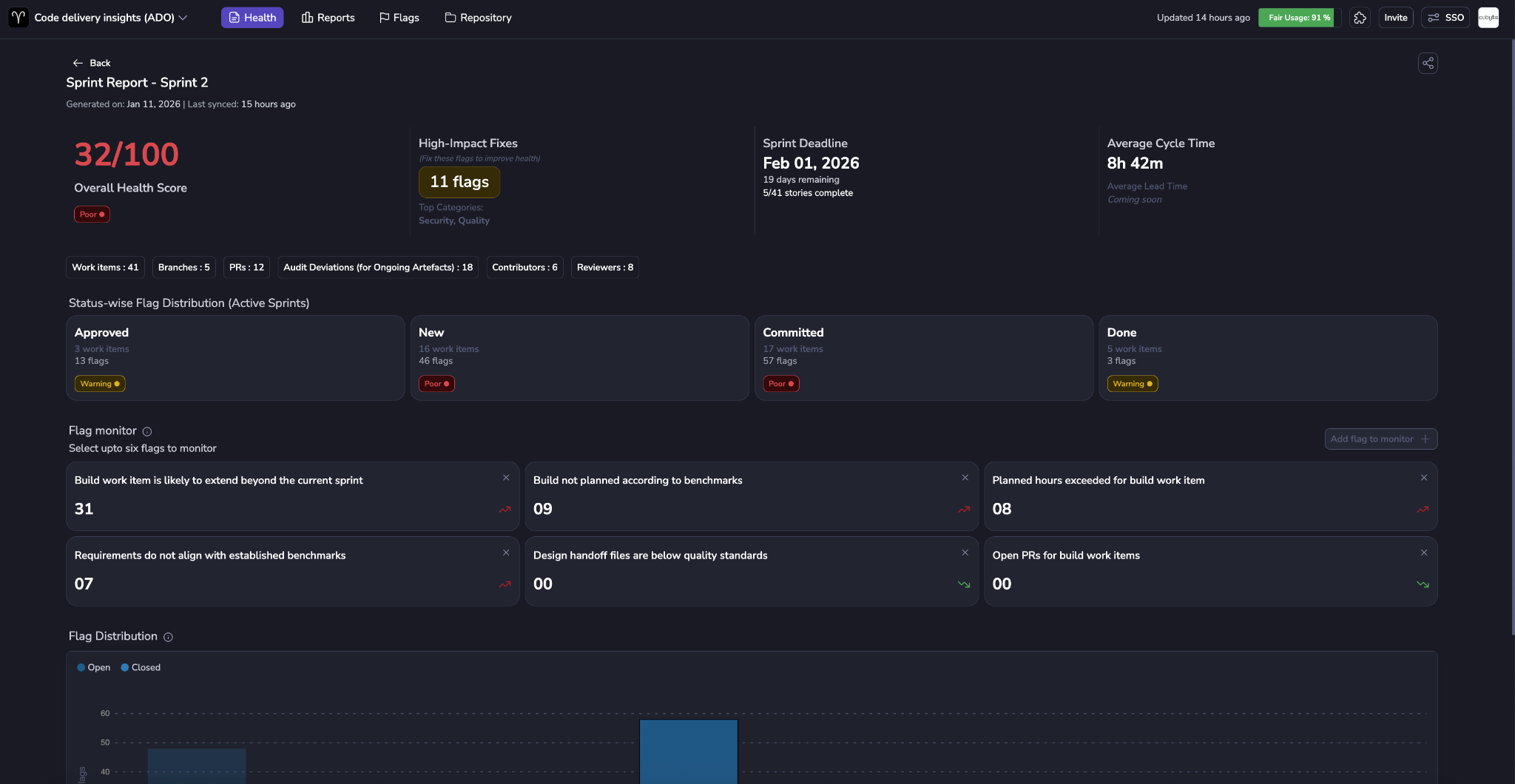
These signals are synthesised into a composite Sprint Health Score that reflects the likelihood of successful sprint completion, not just current status.
High-Impact Fix Identification
To avoid overwhelming teams with raw data, the system identifies high-impact fixes—issues that, if addressed, would most significantly improve sprint health. This prioritisation enables teams to focus on corrective actions that deliver the greatest governance impact with minimal disruption.
Continuous Governance During Execution
Sprint Health governance operates continuously throughout the sprint. It monitors policy-driven flags related to:
Scope and commitment alignment
Planning and estimation discipline
Feature and readiness gaps
Execution and workflow adherence
Each flag represents an explicit governance expectation, evaluated in near real time.
Operational Impact
By introducing governance during sprint execution, organisations benefit from:
Reduced sprint spillovers and last-minute escalations
Earlier identification of execution and quality risks
Improved delivery predictability without added process overhead
Sprint Health governance enables mid-sprint course correction, ensuring that teams remain aligned with delivery intent.
Role-Based Adoption
Delivery Managers identify and mitigate delivery risks early
PMO and Leadership gain objective sprint visibility without manual reporting
Engineering Managers use Sprint Health to maintain execution discipline
Role in the Broader Governance Framework
Ongoing Sprint Health governance serves as the control layer during execution, feeding objective signals into retrospective and continuous governance layers. Without this layer, governance remains reactive, relying on post-sprint analysis and subjective reporting.
Conclusion
Sprint Health governance ensures that delivery risks are detected and addressed while the work is still in progress. By enabling continuous, in-sprint control, it improves delivery outcomes without slowing teams down.
Video: https://www.loom.com/share/c13735e7e2d941438fe0cfbcae3fe5f3
Was this article helpful?
That’s Great!
Thank you for your feedback
Sorry! We couldn't be helpful
Thank you for your feedback
Feedback sent
We appreciate your effort and will try to fix the article