Introduction
Governance Deep-Dive Reports provide topic-based, investigative views across the software delivery lifecycle. While health reports highlight what is at risk, deep-dive reports explain why—by enabling structured drill-downs into delivery execution, code changes, contributor actions, and audit outcomes.
Together, they form a closed-loop governance system.
The Governance Journey of Code
Deep-dive reports represent the journey of code across the SDLC:
Delivery intent → Code changes → People accountability → Audit outcomes
Each stage is explicitly linked to health governance layers, ensuring that risks identified at a high level can always be traced to their source.
Delivery Reports – Execution Context
Delivery reports govern how work progresses through the delivery system, including:
Portfolio and sprint progress
Story, task, and defect status
Sprint execution flow and completion patterns
These reports answer:
Where are delivery risks originating?
Are delays execution-related or structural?
How do sprint outcomes compare over time?
They provide the execution context behind sprint and portfolio health scores.
Code Reports – Technical Reality
Code reports explain how delivery intent materialises in code, covering:
Repository and branch summaries
Pull request status and lifecycle
Code review quality and outcomes
Merged PR traceability and documentation
They allow teams to trace portfolio or sprint health degradation directly into:
Code quality issues
Security or performance risks
Review and merge practices
Code reports form the bridge between delivery signals and technical reality.
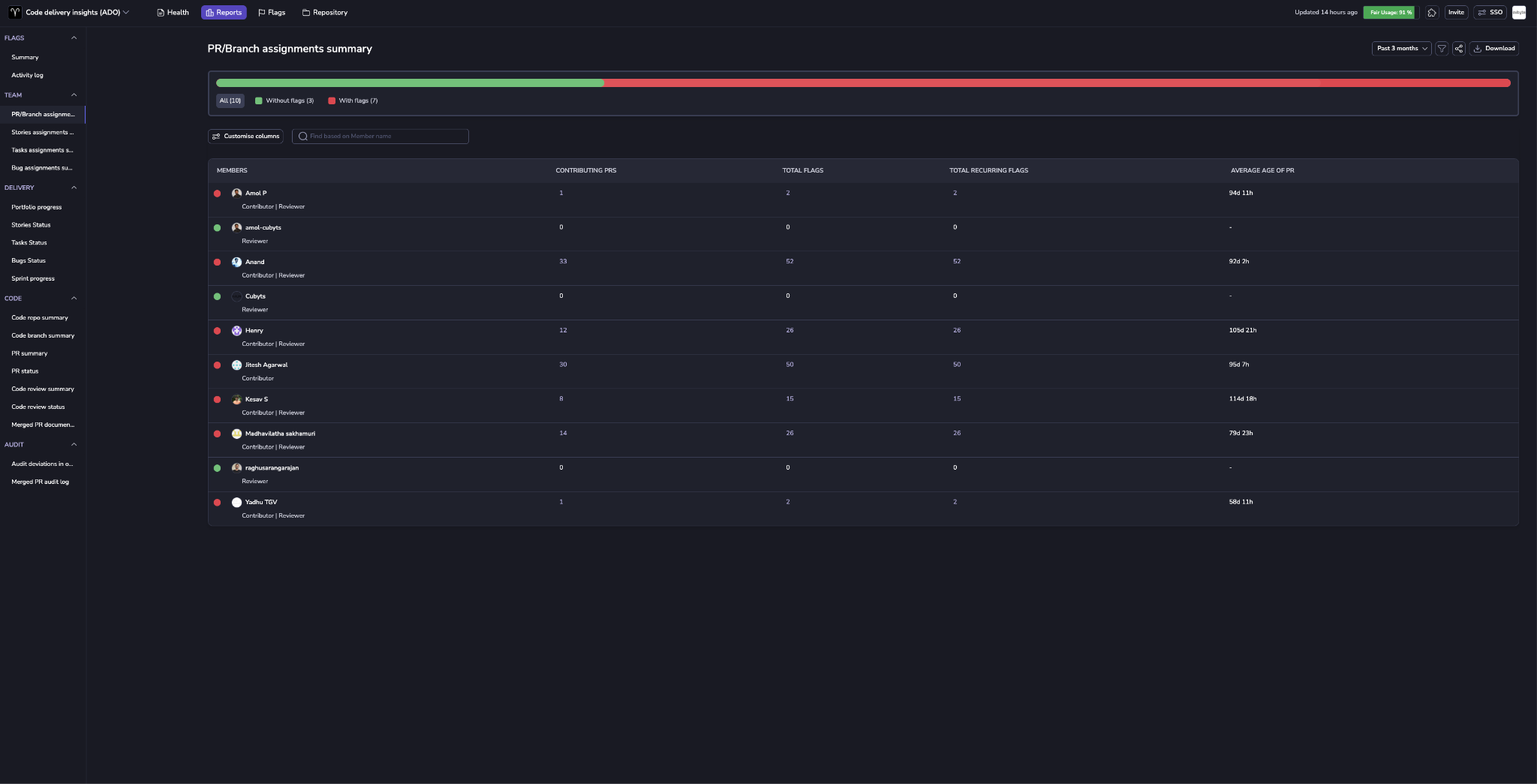
Team Reports – Accountability and Ownership
Team reports connect delivery and code activity to people and ownership, including:
Work item, PR, and branch assignments
Review participation and load
Concentration of risk across contributors
These reports enable:
Constructive accountability
Capacity and workload balancing
Targeted coaching and intervention
They ensure governance is actionable and fair, not abstract.
Audit Reports – Compliance and Evidence
Audit reports capture deviations from defined governance expectations, including:
Workflow and process violations
Missing approvals or traceability gaps
Deviations in merged pull requests
Immutable audit logs for ongoing and completed artifacts
Audit reports provide the evidentiary layer required for compliance, reviews, and regulatory assurance.
Linking Health Reports to Deep-Dive Reports
Health reports (Sprint Health, Portfolio Health, Predictive Repository Health) identify where risk exists. Governance deep-dive reports explain why that risk exists.
This linkage enables:
Direct drill-down from health signals to root cause
Faster, evidence-based remediation
Elimination of manual investigation and data stitching
Governance becomes continuous, explainable, and closed-loop.
Role-Based Value
Delivery Leaders diagnose execution and flow issues
Engineering Leaders trace quality and risk to code and practices
Team Leads manage accountability and capacity
Audit & Compliance Teams validate adherence with evidence
All roles operate on a shared governance foundation, viewed through role-specific lenses.
Conclusion
Governance Deep-Dive Reports ensure that no health signal exists in isolation. By linking delivery, code, people, and audit outcomes, Cubyts enables end-to-end traceability, faster resolution, and sustained governance maturity across the SDLC.
Video: https://www.loom.com/share/f125a949aa054a45a0035a2b6927e0b0
Was this article helpful?
That’s Great!
Thank you for your feedback
Sorry! We couldn't be helpful
Thank you for your feedback
Feedback sent
We appreciate your effort and will try to fix the article