Introduction
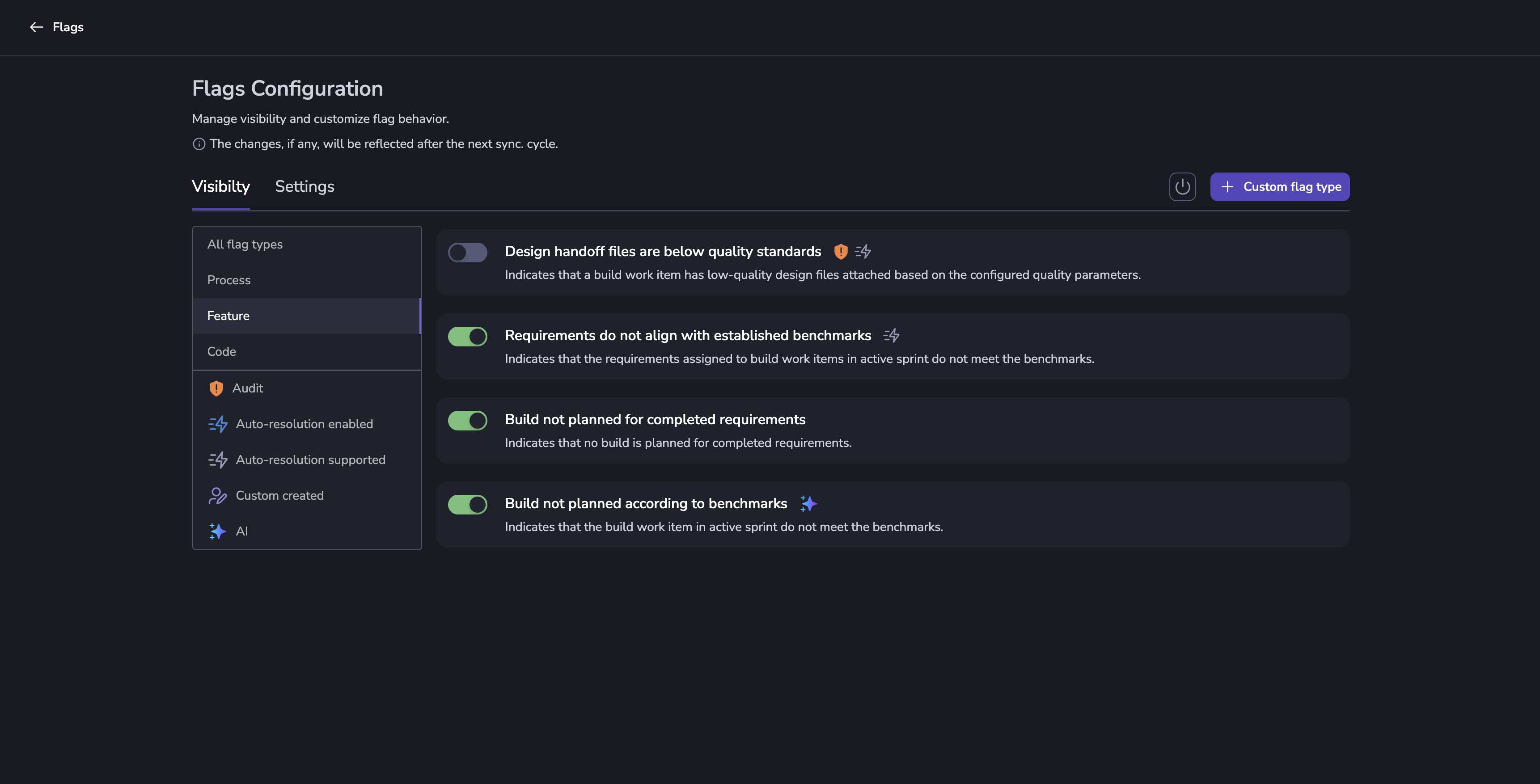
Feature Flags act as governance enablers by ensuring that what teams build is well-defined, well-designed, and well-planned before execution begins. While health reports highlight delivery risk and process flags explain execution drift, Feature Flags focus on the quality of inputs that form the foundation of successful delivery.
They prevent weak feature definitions from propagating downstream into rework, delays, and quality degradation.
Governance Objective
The objective of Feature Flags is to ensure that features entering development are:
Clearly defined and aligned with intent
Designed to agreed quality standards
Planned in a way that supports predictable execution
By governing inputs early, Feature Flags reduce the cost and impact of change later in the SDLC.
What Feature Flags Monitor
Feature Flags continuously evaluate readiness signals such as:
Requirement completeness and benchmark alignment
Design handoff quality and standards compliance
Build planning consistency with defined benchmarks
Alignment between completed requirements and planned builds
Each flag represents a foundation-level governance expectation.
Preventing Feature Drift
Feature drift occurs when the original intent of a feature erodes between definition, design, and execution. Feature Flags detect this drift early by identifying:
Requirements that do not meet quality benchmarks
Designs that are incomplete or below expected standards
Builds that are planned without validated inputs
This enables teams to correct the course before execution begins.
Linking Feature Flags to Health Signals
Health reports (Sprint Health, Portfolio Health, Predictive Repository Health) identify delivery risk. Feature Flags explain whether that risk originates from weak feature foundations.
For example:
Sprint instability can be traced to poorly defined requirements
Rework trends can be linked to incomplete designs
This linkage creates a cause-and-effect governance chain:
Weak inputs → Execution drift → Health degradation
Operational Impact
By strengthening feature foundations, organisations achieve:
Reduced rework and mid-sprint scope changes
More predictable sprint execution
Higher-quality delivery outcomes
Fewer late-stage surprises
Feature Flags improve outcomes without slowing teams down, by improving readiness rather than enforcing gates.
Role-Based Value
Engineering Managers receive cleaner inputs for execution
Delivery Leaders benefit from improved predictability
Role in the Overall Governance Framework
Feature Flags:
Complement Process Flags by governing what enters execution
Strengthen Ongoing Sprint Governance by improving readiness
They form the foundation integrity layer of the governance framework.
Conclusion
Feature Flags ensure that software delivery starts on solid ground. By governing the quality of requirements, designs, and build plans, they prevent weak foundations from undermining delivery outcomes, enabling faster, more predictable, and higher-quality execution.
Was this article helpful?
That’s Great!
Thank you for your feedback
Sorry! We couldn't be helpful
Thank you for your feedback
Feedback sent
We appreciate your effort and will try to fix the article