Introduction
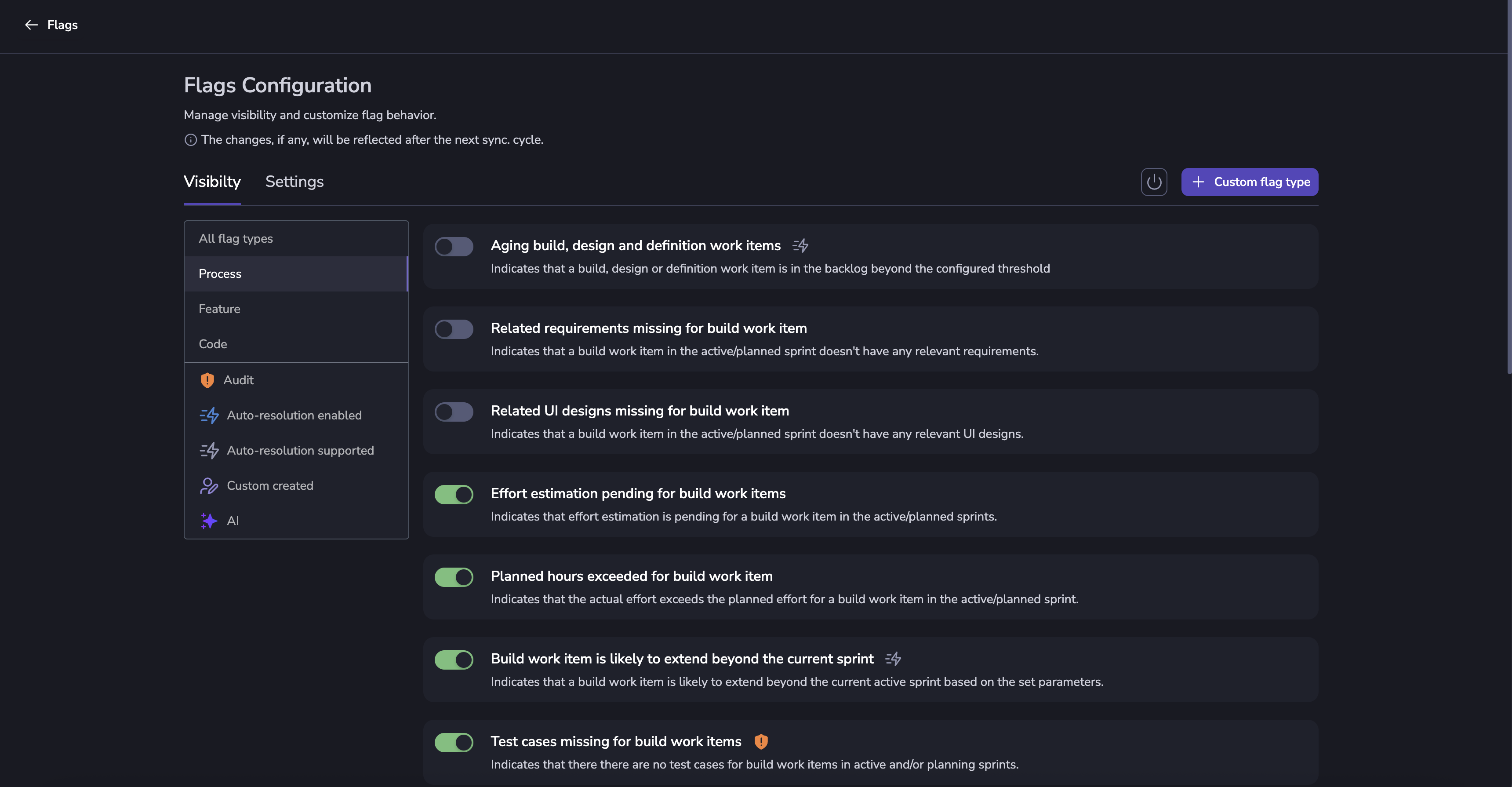
Process Flags act as foundational governance enablers by continuously monitoring how teams execute delivery, not just what they deliver. While health reports indicate where delivery, quality, or predictability is at risk, Process Flags explain why—by surfacing deviations from defined delivery processes.
They ensure that governance is embedded into everyday execution rather than enforced through periodic reviews.
Governance Objective
The objective of Process Flags is to ensure that teams consistently follow defined, agreed-upon delivery practices, while allowing flexibility in how those practices are configured.
Specifically, Process Flags aim to:
Detect execution drift early
Prevent silent accumulation of process debt
Enable timely correction before delivery outcomes degrade
What Process Flags Monitor
Process Flags continuously evaluate signals across the SDLC toolchain, including:
Backlog ageing and readiness gaps
Missing requirements, designs, or test cases
Estimation gaps and effort overruns
Sprint spillover likelihood
Overloaded team members
Workflow and approval violations
Traceability gaps between work items and code
Each flag represents a governance expectation that is evaluated automatically and continuously.
Process Drift Detection
Process drift occurs when teams gradually deviate from agreed ways of working—often unintentionally. Examples include:
Starting work without complete requirements or designs
Consistently underestimating effort
Allowing PRs to merge without proper reviews
Carrying unfinished work across sprints
Process Flags surface these drifts as they emerge, not after outcomes are affected.
Linking Process Flags to Health Signals
Health reports (Sprint Health, Portfolio Health, Predictive Repository Health) identify delivery risk and degradation. Process Flags provide the explanatory layer beneath those signals.
For example:
Poor Sprint Health can be traced to estimation gaps or overloaded team members
Portfolio-level instability can be linked to recurring planning or workflow deviations
This creates a closed-loop governance model where:
Health signals → Process deviations → Corrective action
Operational Impact
By introducing continuous process governance, organisations achieve:
Earlier risk detection without additional meetings
Reduced sprint spillovers and execution surprises
More consistent delivery outcomes across teams
Objective evidence for retrospectives and audits
Process Flags enable governance that is preventive and corrective, not punitive.
Role-Based Value
Delivery Managers / PMO trace delivery risk to process causes
Team Leads balance workload and readiness
Engineering Managers detect execution discipline gaps early
Audit Teams gain evidence-backed visibility into process adherence
Role in the Overall Governance Framework
Process Flags:
Power Ongoing Governance by explaining sprint health degradation
Feed Retrospective Governance with objective execution data
Strengthen Predictive Governance by improving signal quality
They form the process integrity layer of the governance framework.
Conclusion
Process Flags ensure that delivery health signals are never abstract. By continuously detecting process drift and linking it directly to health outcomes, they enable organisations to govern delivery with clarity, consistency, and confidence.
Was this article helpful?
That’s Great!
Thank you for your feedback
Sorry! We couldn't be helpful
Thank you for your feedback
Feedback sent
We appreciate your effort and will try to fix the article