Cubyts Software Development & Governance is an AI-native, agentic application built on the Cubyts Context Engine.
The Context Engine continuously builds a semantic understanding of the software development lifecycle by connecting to the systems where software is defined, designed, built, documented and operated. It transforms this information into a comprehensive SDLC Knowledge Graph that provides the context required by AI agents to reason across the software lifecycle.
Together, the Context Engine and Cubyts agents address two fundamental challenges emerging in AI-native software development:
1. AI coding agents lack the context required for complex software
AI coding agents are extremely effective when the task and its context are local and well defined. However, as software complexity increases, the context required to make the right decision extends far beyond the repository.
An agent may be able to find the relevant files, but still miss:
Architectural decisions and design patterns
Dependencies across code areas and business domains
Continuously evolving engineering standards
Related requirements, documentation, constraints and expectations
A real-time understanding of what is actually being built
This is why coding agents can perform exceptionally well on simple tasks, but increasingly require re-prompting, re-explanation and human intervention as complexity grows.
The missing ingredient is not intelligence. It is context.
2. AI-native development is creating new governance gaps
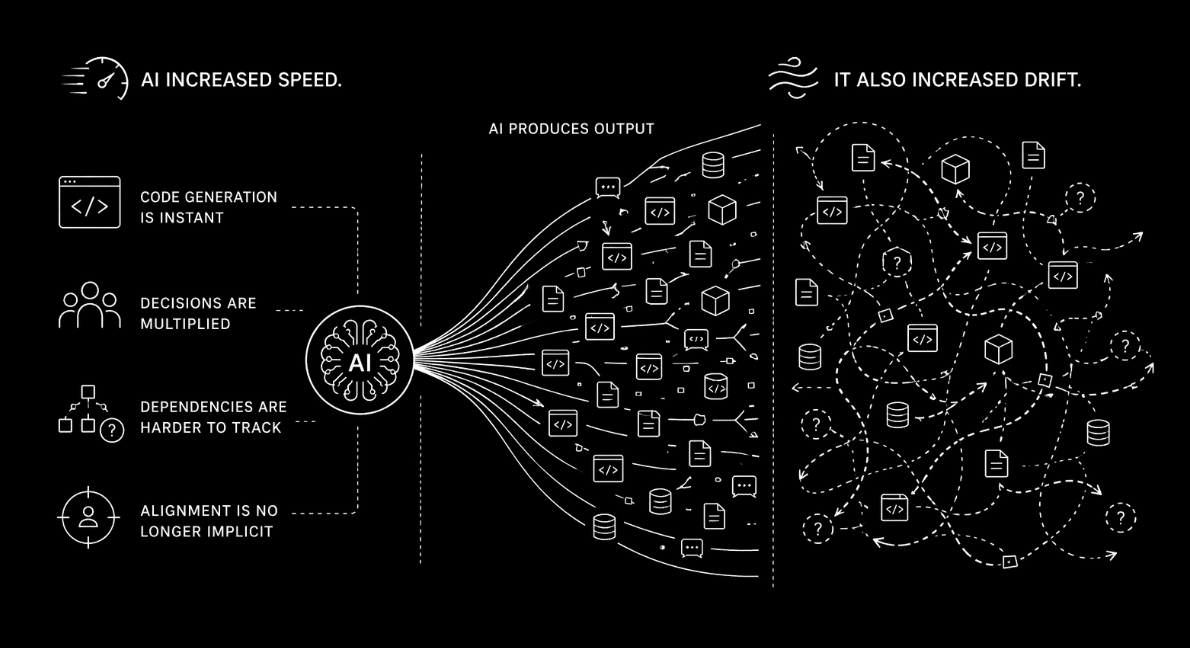
AI has dramatically increased the velocity at which software can be defined and built. However, traditional governance mechanisms were designed for a slower, more human-driven development process.
As the velocity of change increases, organizations find it increasingly difficult to maintain:
Visibility into the health of execution artefacts and predictability of delivery
Alignment of requirements and input documents with enterprise expectations
Consistency between build plans and actual execution
Alignment between the original intent and the resulting code
Synchronization between code and its functional, technical and test documentation
The result is a growing gap between what was intended, what was planned, what was built and what is ultimately released.
These gaps are the governance leaks of AI-native development.
Why Cubyts?
Cubyts is the missing context and control layer for AI-native software development.
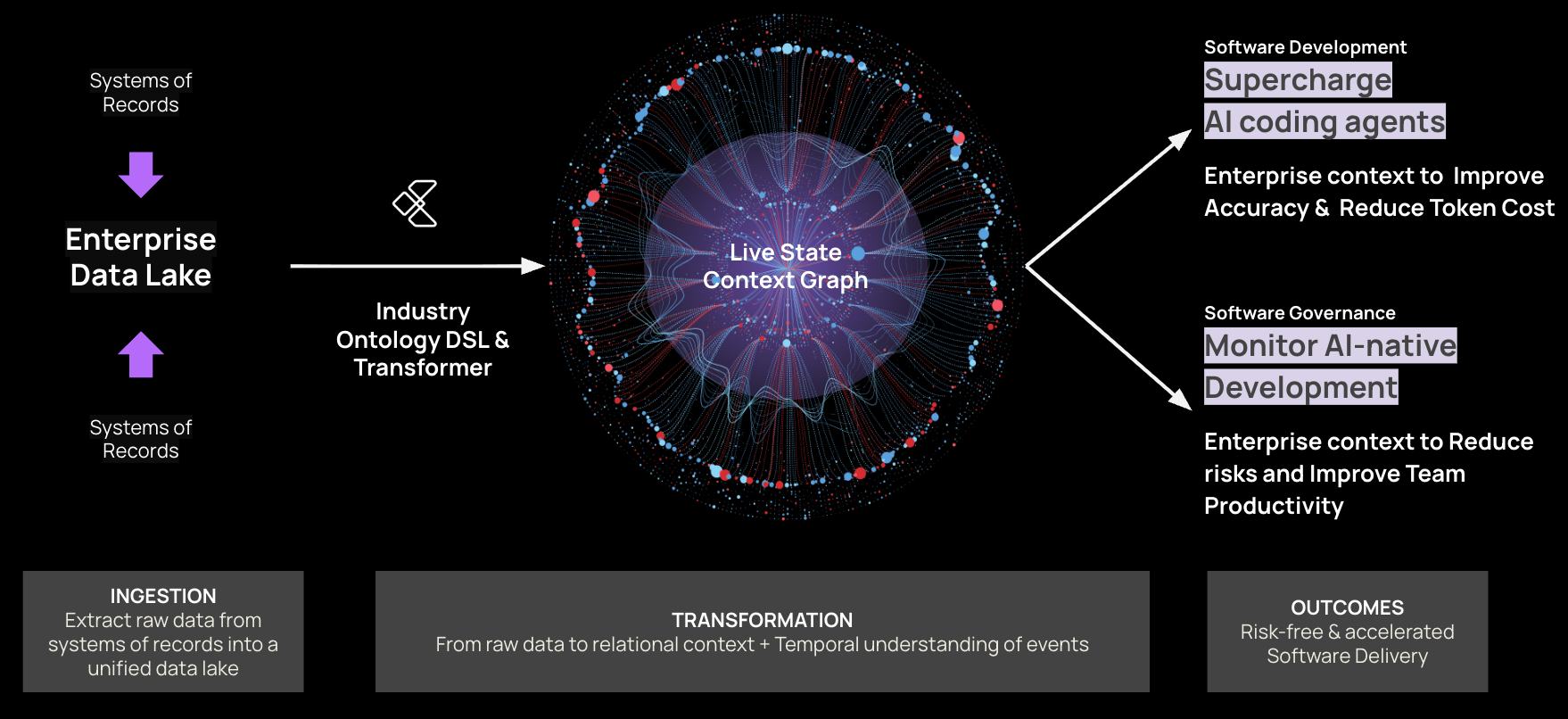
Cubyts connects to the systems across the SDLC — including planning and project management systems such as Jira, code repositories such as GitHub, documentation platforms such as Confluence, Google Drive and SharePoint, and support systems such as Jira Service Management.
It continuously ingests and understands this information to construct a semantic SDLC Knowledge Graph containing the entities, relationships, dependencies, decisions and inferred context that exist across these systems.
For code, Cubyts combines semantic understanding with Abstract Syntax Tree and Symbol Graph representations, enabling deep understanding of code structure, dependencies and relationships across the codebase.
This Knowledge Graph becomes the context layer for AI-native software development.
Context for AI coding agents
Cubyts can serve SDLC context to coding agents such as Claude Code and Cursor, enabling them to reason beyond the local repository.
Agents can use this context for use cases such as contextual code review, dependency analysis, impact analysis and root-cause analysis — reducing the need for developers to repeatedly provide missing context.
Governance agents for AI-native development
Cubyts also provides a broad set of governance agents that continuously evaluate the alignment between intent, planning, execution and code.
Examples include:
ADR Drift Auditor
Identifies deviations between architectural decisions and the code released to production by connecting ADRs with implementation.
PRD Drift Auditor
Identifies deviations between product requirements and the software ultimately built and released.
Code Reviewer
Performs graph-based, live analysis of code changes to enforce engineering standards, detect issues early and help cleanse code before merge — improving code quality while reducing review effort and rework.
Documentation & Test Case Generator
Automatically generates functional, technical and test-case documentation from the evolving codebase and keeps it synchronized with code changes, reducing knowledge gaps and operational risk.
And more.
Cubyts Context Engine
At the foundation is the Cubyts Context Engine.
It performs three fundamental functions:
Connect
Connects to the enterprise SDLC toolchain and continuously ingests information from the systems where software is planned, designed, developed, documented and operated.
Understand
Transforms this information into a semantic knowledge graph representing entities, relationships, dependencies, decisions and inferred facts across the SDLC.
Serve
Makes this context available to Cubyts agents — and to AI development workflows — so that decisions and actions can be grounded in the broader software lifecycle rather than isolated local context.
This creates a continuous loop:
SDLC Data → Knowledge Graph → Context → AI Agents → Actions → Updated SDLC Context
The Cubyts Vision
AI is changing how software is developed. The next challenge is ensuring that this new velocity does not come at the cost of context, quality, alignment and control.
Cubyts provides the context and control plane for AI-native software development.
Was this article helpful?
That’s Great!
Thank you for your feedback
Sorry! We couldn't be helpful
Thank you for your feedback
Feedback sent
We appreciate your effort and will try to fix the article