1. Architecture at a Glance
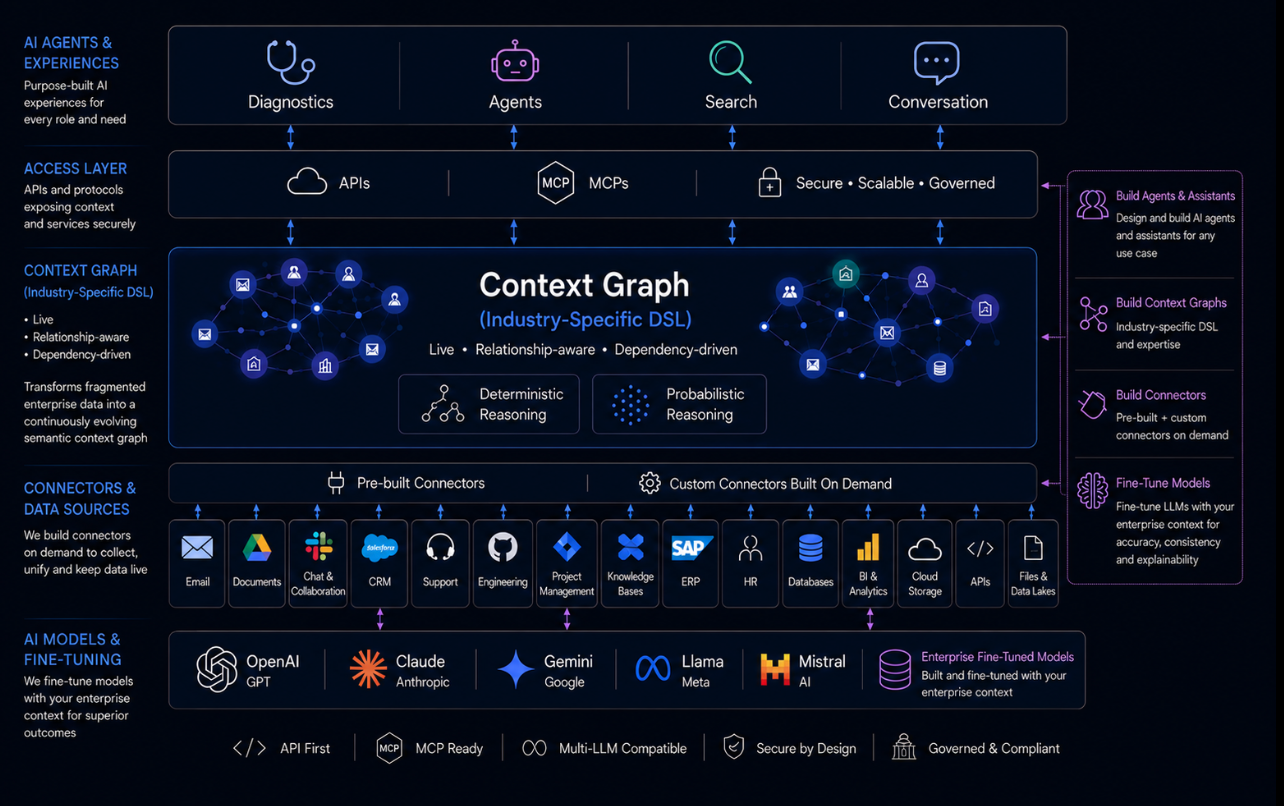
Cubyts is an AI-native platform built around a continuously evolving Context Graph. The platform connects to enterprise data and software development systems through pre-built and custom connectors, transforms fragmented information into relationship-aware and dependency-aware context, and exposes that context securely through APIs and MCPs to AI agents, applications, and experiences.
The architecture separates enterprise context from the AI models and experiences that consume it. This allows Cubyts to support multiple foundation models, purpose-built agents, and domain-specific applications while maintaining a consistent, governed source of enterprise context.
2. Architectural Flow
The architecture can be understood as a five-stage flow:
Connect — collect and synchronize data from enterprise systems through connectors.
Understand — transform fragmented data into a continuously evolving Context Graph using domain-specific semantics, relationships, dependencies, and reasoning.
Expose — make governed context and platform capabilities available through APIs and MCPs.
Reason — apply foundation models, deterministic rules, and probabilistic reasoning.
Experience — deliver intelligence through diagnostics, agents, search, conversation, and purpose-built applications.
3. AI Models & Fine-Tuning
The AI model layer provides the intelligence used by Cubyts agents and experiences. Cubyts is designed to remain model-provider agnostic, allowing different foundation models to be used according to the task, enterprise requirements, performance, cost, and security needs.
3.1 Model Support
OpenAI / GPT
Claude / Anthropic
Enterprise fine-tuned models (as a service).
3.2 Enterprise Context and Fine-Tuning
Where required, enterprise context can be used to adapt or fine-tune models for specific domains and outcomes. The architecture keeps the model layer decoupled from the Context Graph, so the enterprise context remains reusable even as models evolve.
4. Connectors & Data Sources
The connector layer provides the mechanism for bringing enterprise information into the Cubyts platform. Cubyts supports pre-built connectors as well as custom connectors built on demand.
4.1 Data Sources
Engineering and source-code systems
Project and work management systems
Knowledge bases and documentation
Collaboration and communication systems
And more based on customer’s requirements
4.2 Connector Responsibilities
Secure authentication and authorization to source systems
Data acquisition and synchronization
Incremental change detection where supported
Normalization and metadata capture
Maintaining data freshness and source provenance
Supporting enterprise-specific or proprietary systems through custom connectors.
Connectors are responsible for collecting and synchronizing information; the Context Graph is responsible for turning that information into connected, usable context.
5. Context Graph
The Context Graph is the architectural core of Cubyts. It transforms fragmented enterprise data into a continuously evolving semantic representation of the organization, its entities, activities, relationships, and dependencies.
5.1 Industry-Specific DSL
The Context Graph is structured using an industry- or domain-specific language (DSL) that defines the entities, relationships, semantics, and dependencies relevant to a particular business context. For software development and governance, this can include requirements, features, designs, work items, repositories, code, pull requests, defects, releases, teams, policies, and other SDLC entities.
5.2 Characteristics of the Context Graph
Live: continuously updated as source systems change
Relationship-aware: understands how entities are connected
Dependency-driven: captures dependencies and their implications
Semantic: represents meaning rather than only raw records
Contextual: combines information across multiple enterprise systems
5.3 Reasoning
Cubyts combines deterministic and probabilistic reasoning to derive intelligence from the Context Graph.
Deterministic reasoning can be used for:
Rules and policies
Compliance conditions
Thresholds and validations
Known relationships and dependencies
Probabilistic reasoning can be used for:
Semantic interpretation
Classification and inference
Summarization
Recommendations
LLM-based reasoning
Combining both approaches enables Cubyts to use the precision and auditability of deterministic logic together with the flexibility of probabilistic AI.
6. Access Layer
The access layer provides governed interfaces through which applications, agents, and external AI environments can consume Cubyts context and capabilities.
6.1 APIs
Cubyts exposes platform capabilities and context through APIs, enabling applications and services to integrate with the platform without directly accessing underlying source systems.
6.2 MCPs
Model Context Protocol (MCP) interfaces make Cubyts context and capabilities accessible to compatible AI agents and agentic development environments. This enables Cubyts to act as a governed context and capability layer within broader agentic workflows.
6.3 Security, Scalability and Governance
Authentication and authorization
Tenant and data isolation
Access controls and permissions
Secure interfaces
Auditability and governance
Scalable platform services
A core architectural principle is that enterprise context is exposed through controlled interfaces rather than requiring consuming applications or agents to connect directly to underlying source systems.
7. AI Agents & Experiences
The top layer delivers purpose-built intelligence to users and applications. These experiences share the same underlying Context Graph and access layer rather than maintaining separate, disconnected sources of enterprise context.
Diagnostics: Purpose-built intelligence for identifying conditions, issues, risks, and opportunities.
Agents: Autonomous or semi-autonomous workflows that reason over enterprise context and perform defined tasks.
Search: Context-aware retrieval across connected enterprise information.
Conversation: Natural-language interaction with enterprise context, intelligence, and capabilities.
8. Extensibility
The architecture is designed not only to deliver packaged Cubyts applications, but also to enable organizations to extend the platform for their own domains and use cases.
Build Agents & Assistants: Design and build purpose-specific AI agents and assistants using governed enterprise context.
Build Context Graphs: Define industry- or domain-specific DSLs and context models.
Build Connectors: Extend the platform to proprietary or unsupported enterprise systems.
Fine-Tune Models: Adapt models using enterprise context for domain-specific accuracy and outcomes.
9. Architectural Principles
10. Cubyts as a Context Platform
The architecture establishes Cubyts as more than an application layer over enterprise systems. The Context Graph acts as a reusable context foundation that can support multiple applications, agents, AI models, and user experiences.
Enterprise systems generate data. Cubyts connects and contextualizes that data. The Context Graph creates a unified understanding of the enterprise. APIs and MCPs make that context available to applications and agents. Models and reasoning capabilities turn context into intelligence, while Cubyts experiences deliver that intelligence to users.
11. Relationship to Cubyts Applications
Cubyts applications such as SDLC Governance, Code Intelligence, Delivery Intelligence, and other agentic experiences are consumers of the underlying Context Engine. They use shared context, relationships, dependencies, reasoning capabilities, and governed access rather than independently reconstructing enterprise context.
Was this article helpful?
That’s Great!
Thank you for your feedback
Sorry! We couldn't be helpful
Thank you for your feedback
Feedback sent
We appreciate your effort and will try to fix the article